A battery can be assembled in America, integrated into an American defense system, and still depend on materials sourced or processed in China. As batteries become increasingly critical to modern military capabilities, that dependence represents a growing national security vulnerability.
From unmanned aerial systems and autonomous ground vehicles to soldier-worn electronics, tactical communications, naval platforms, and expeditionary microgrids, defense applications demand reliable energy storage capable of performing under challenging conditions. Performance, safety, durability, and consistent power delivery are essential, but reliability extends beyond the finished battery. It also depends on the ability to source, manufacture, and deliver critical materials through secure and dependable supply chains.
For the U.S. defense industrial base, ensuring access to qualified domestic battery materials is becoming as important as developing the next generation of battery technologies.
Mission-Critical Power Requires Secure Supply Chains
Defense batteries must meet demanding performance requirements, often operating under extreme temperatures, repeated cycling, vibration, and unpredictable field conditions. Different applications require different combinations of energy density, power delivery, safety, and service life, making material quality and consistency essential.
Yet even a battery that meets every technical requirement can introduce strategic risk if its critical materials depend on concentrated foreign supply chains. Supply disruptions can constrain cell manufacturing, delay production schedules, and expose defense programs to geopolitical tensions, export restrictions, and changing procurement requirements.
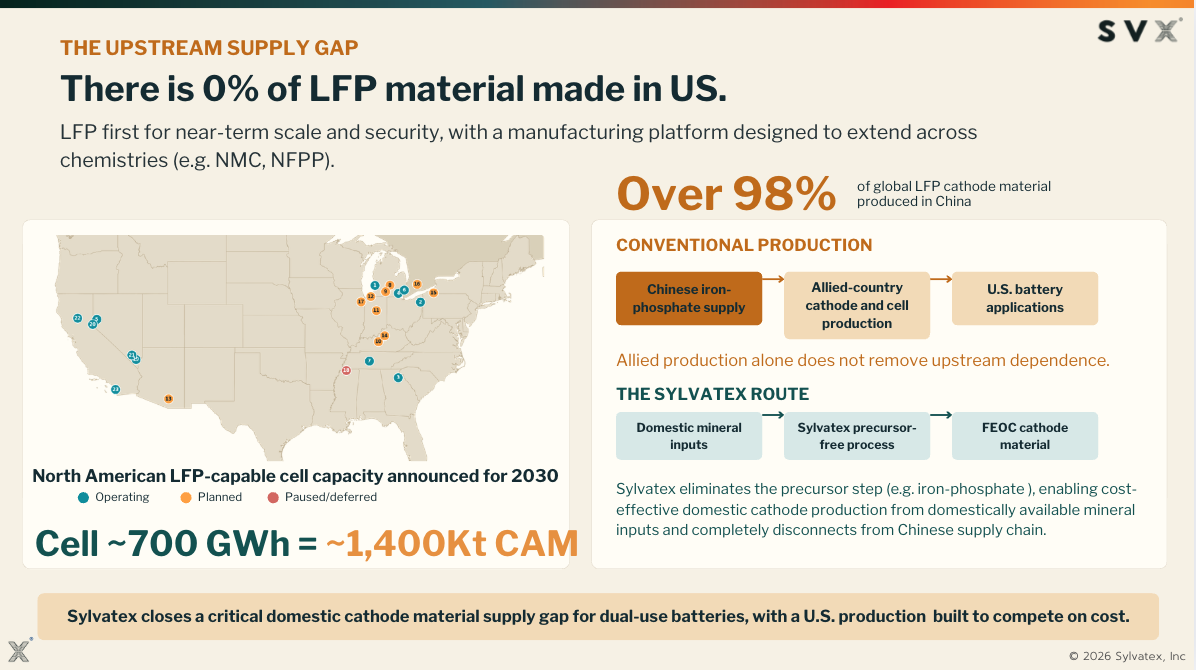
This vulnerability is particularly evident in lithium iron phosphate (LFP), an increasingly attractive chemistry for applications prioritizing safety, long cycle life, and competitive economics. China dominates global LFP cathode active material (CAM) production, including the conventional iron phosphate precursors used to manufacture it.
As a result, batteries assembled in the United States or allied countries may still rely on Chinese-sourced materials. Even domestic cathode manufacturing does not necessarily resolve the issue if the process depends on imported iron phosphate intermediates.
For defense applications, the country where a battery is assembled tells only part of the supply-chain story. The origins of its critical components, how they are processed, and whether they can be traced and qualified are equally consequential.
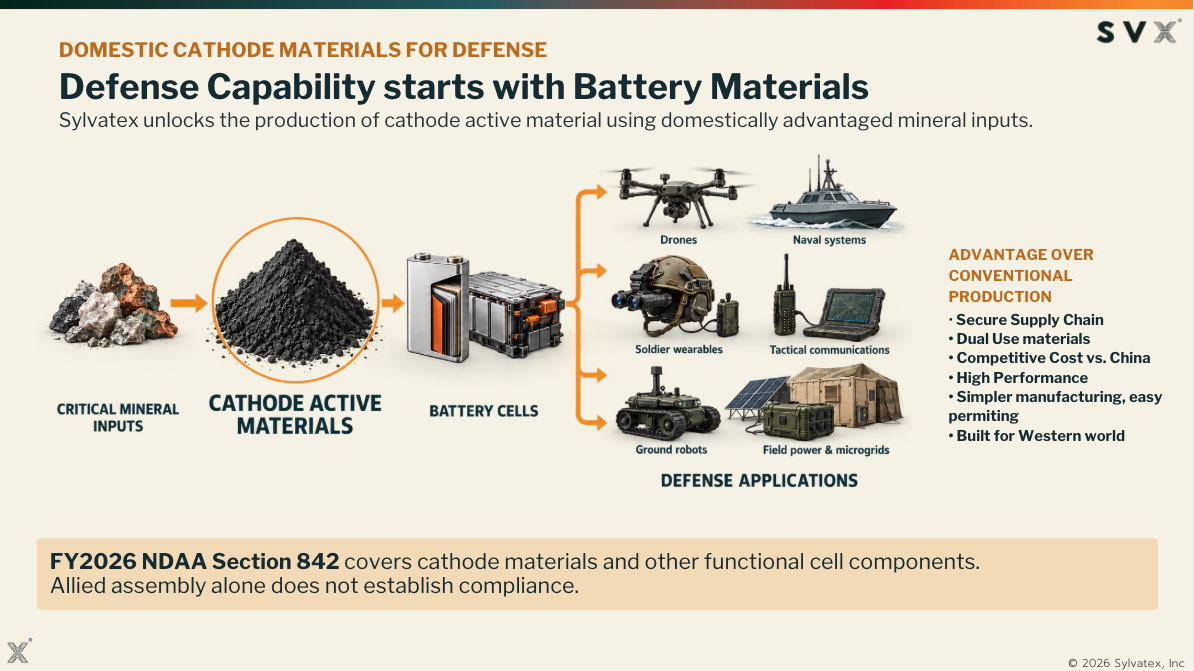
Section 842 Raises the Stakes
The Fiscal Year 2026 National Defense Authorization Act makes addressing these vulnerabilities increasingly urgent. Section 842, codified at 10 U.S.C. § 4865, establishes restrictions on Department of Defense procurement of advanced batteries and cells associated with foreign entities of concern (FEOCs).
Importantly, these restrictions extend beyond final cell assembly to functional cell components, including cathode materials, and certain upstream sourcing, refining, and production activities. The requirements are phased in beginning January 1, 2028, for new defense acquisition programs, followed by January 1, 2029, for standard batteries and January 30, 2031, for existing acquisition programs.
Although the law includes defined exceptions and waiver provisions, its implications for the defense battery supply chain are significant. Domestic or allied assembly alone does not establish compliance, and manufacturers must increasingly account for where materials originate and how they are processed.
With qualification cycles often requiring extensive testing, production validation, and system integration, the approaching 2028 deadline makes early investment in qualified domestic supply chains particularly important. Manufacturers need to establish reliable material sources and validation pathways well before procurement restrictions take effect.
Building Security Into the Material Pathway
At Sylvatex, we are addressing a critical upstream dependency in conventional LFP manufacturing: the iron phosphate precursor.
Our proprietary solid-state, precursor-free process produces LFP cathode material using more broadly available inputs, including iron oxide, lithium, and phosphate materials. By eliminating the conventional iron phosphate intermediate and associated processing steps, our technology creates a pathway to domestic cathode production without relying on China-dominated precursor supply chains.
The differentiation goes beyond changing raw materials. Our proprietary process architecture and manufacturing know-how are designed to simplify production, reduce equipment and resource requirements, and enable the use of traceable domestic and allied inputs. This creates an opportunity to address both supply-chain security and the economics of establishing competitive domestic manufacturing.
For defense applications, these advantages are particularly relevant. A more accessible feedstock pathway can reduce exposure to concentrated foreign suppliers, while simpler manufacturing can help make the domestic production capacity needed to support defense programs more economically feasible.
However, developing a secure material pathway is only the beginning. Inputs must be appropriately sourced and documented, manufacturing must demonstrate consistency and repeatability, and the resulting materials must satisfy the technical requirements of battery manufacturers and defense applications.
Sylvatex is advancing these capabilities through industrial scale-up and customer qualification, with the objective of establishing dependable domestic cathode production that can support both commercial and defense markets.
Growing Defense Engagement and Industry Collaboration
The importance of securing domestic battery materials was reinforced during Sylvatex’s participation in ARPA-E’s Next Generation Batteries for Tactical Systems event, held alongside the Association of the United States Army (AUSA) annual meeting in October 2026.
Discussions with defense organizations, battery manufacturers, and industry stakeholders highlighted the growing need to connect advanced material technologies with defense qualification requirements and dependable domestic manufacturing capacity.
Following the event, Lockheed Martin issued a formal Letter of Support on October 22, 2026, recognizing Sylvatex’s potential to help address the limited availability of qualified domestic cathode materials. The letter specifically identifies dependence on foreign-controlled precursor supply chains as a strategic vulnerability and highlights Sylvatex’s precursor-free technology as a promising pathway toward more secure and traceable LFP production.
Lockheed Martin also identified potential areas of collaboration spanning material readiness and defense qualification, supply-chain integration, strategic investment and programmatic support, and future sourcing opportunities. This engagement provides important validation of the need for domestic cathode manufacturing while helping establish a pathway toward the technical qualification and production readiness required by defense programs.
Equally important is connecting domestic cathode production with downstream battery manufacturers capable of evaluating and integrating these materials into finished cells.
In October 2026, Sylvatex announced a strategic collaboration with American Lithium Energy (ALE), a California-based battery manufacturer serving defense, aerospace, and other demanding applications. The collaboration establishes a phased pathway to evaluate Sylvatex’s LFP materials for integration into ALE’s battery cells and explore broader manufacturing and commercial opportunities.
Sylvatex is also working with Lithion Battery through a technology development collaboration focused on evaluating and integrating our cathode materials into battery cells. Together, these relationships demonstrate growing engagement with U.S. battery manufacturers interested in developing more secure domestic supply chains.
These partnerships are essential because producing a promising cathode material is not the same as establishing a qualified battery supply chain. Materials must demonstrate consistent performance, while cell manufacturers must validate safety, reliability, cycle life, and other application-specific characteristics. Defense applications introduce additional requirements for qualification, sourcing, and traceability.
By working with downstream manufacturers during technology development and scale-up, Sylvatex is helping connect upstream materials innovation with the technical requirements and manufacturing capabilities needed for future defense deployment.
From Supply-Chain Risk to Defense Readiness
Strengthening America’s defense battery supply chain will require coordinated action among critical mineral suppliers, cathode manufacturers, battery-cell producers, system integrators, defense primes, and government programs.
The immediate priorities are clear: establish better visibility into defense battery demand and qualification requirements, support the technical validation of domestic materials, and develop manufacturing capacity capable of supplying qualified products reliably and competitively.
These efforts must advance together. Qualifying new materials without a credible production pathway does not resolve supply constraints, just as building manufacturing capacity without customer validation does not establish a defense-ready supplier.
Sylvatex is working to bridge that gap through its differentiated LFP manufacturing technology, engagement with Lockheed Martin, and collaborations with American Lithium Energy and Lithion Battery. These relationships are helping align upstream material development with downstream battery qualification and future manufacturing needs.
As defense systems become increasingly dependent on batteries, supply-chain resilience must be treated as an essential part of operational readiness. Section 842 reinforces the urgency, but the underlying objective extends beyond compliance: establishing reliable access to high-performance materials that can support critical defense capabilities over the long term.
America cannot build a resilient defense battery supply chain by securing final assembly while leaving its critical materials exposed. Defense readiness begins long before the battery reaches the battlefield. It begins with the materials.